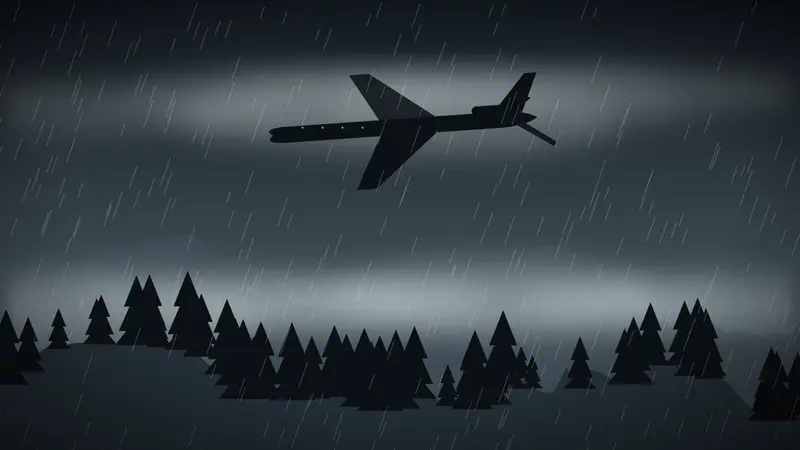
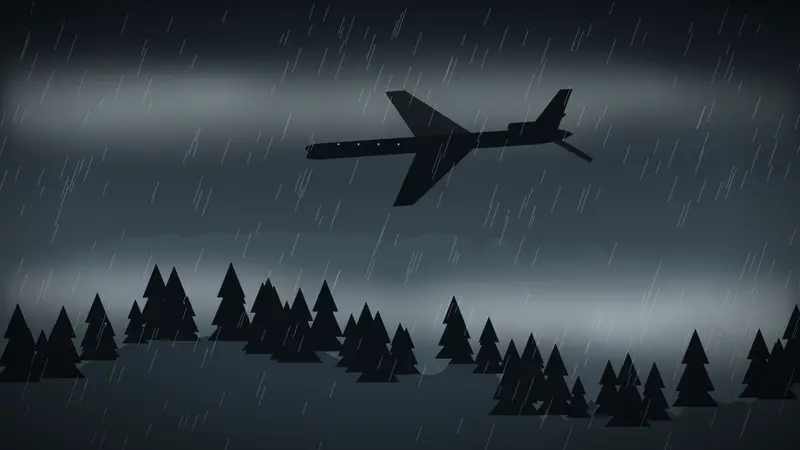
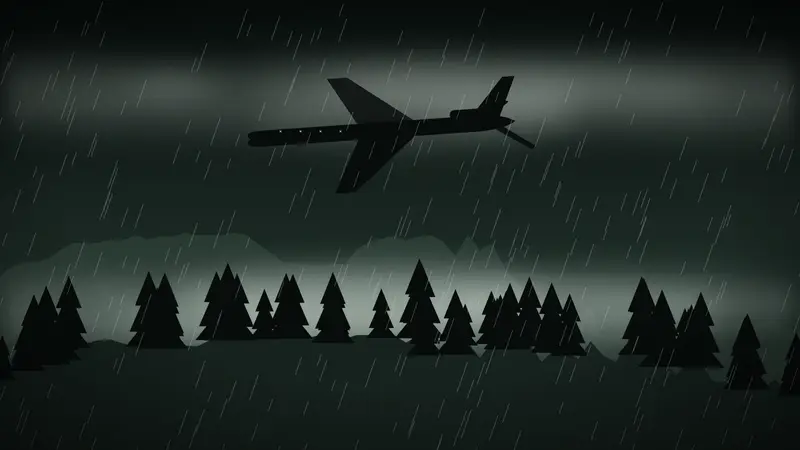
On the night before Thanksgiving 1971, a quiet man in a dark suit ordered a bourbon and soda, handed a flight attendant a note, and calmly hijacked a passenger jet. A few hours later he jumped out of the back of the plane into a storm with $200,000 strapped to his body. He was never seen again.
The short answer: “D.B. Cooper” is the name given to an unidentified man who hijacked Northwest Orient Flight 305 between Portland and Seattle on 24 November 1971. He swapped the passengers for $200,000 and four parachutes, then parachuted from the rear stairs of the Boeing 727 somewhere over southwest Washington. Despite one of the largest manhunts in FBI history, he was never identified. Only about $5,800 of the money has ever been found, and the FBI suspended its active investigation in 2016.
This guide covers the whole case. Each section links to the full file.
What happened on Flight 305?
The man bought his ticket under the name Dan Cooper. Soon after take-off from Portland, he passed a note to flight attendant Florence Schaffner saying he had a bomb, and opened his briefcase to show her wires and red sticks. He was polite and calm the whole time. He asked for $200,000 in twenty-dollar bills and four parachutes, to be delivered when the plane landed in Seattle.
The plane circled Seattle while the FBI gathered the cash and recorded every serial number. After landing, Cooper released the 36 passengers and some of the crew, kept the pilots and one flight attendant, and ordered the plane to fly toward Mexico at low speed and low altitude with the flaps down.
The full hijacking is told in File 01: The Man Who Hijacked a Plane and Vanished.
How did D.B. Cooper escape?
He chose his aircraft well. The Boeing 727 had a rear airstair that could be lowered in flight, a feature almost no other airliner shared. At around 8 p.m., the crew saw a warning light showing the stairs had opened, and felt a change in cabin pressure. When the plane landed in Reno, the cabin was empty.
Cooper had jumped at night into heavy rain and wind, wearing a business suit and loafers. He left behind two parachutes, his black clip-on tie and a tie clip. After the case, the FAA required a device on all 727s, later nicknamed the “Cooper vane”, that locked the rear stairs shut in flight.
Read File 02: The Night Jump Into Darkness.
How did the FBI search for D.B. Cooper?
The FBI called the case NORJAK, for Northwest hijacking. Soldiers and agents searched the forests of southwest Washington on foot and from the air. The case file grew to dozens of volumes, and agents examined more than a thousand people as possible suspects. The name “D.B. Cooper” itself came from a reporting mix-up: the FBI had questioned a man with those initials, but he was not the hijacker.
Read File 03: The Largest Manhunt in FBI History.
Who are the main D.B. Cooper suspects?
Many names have been put forward, but none has ever been proven:
- Richard McCoy Jr. copied the hijacking months later and was caught, but the FBI never treated him as a strong match.
- Kenneth Christiansen was a Northwest Orient employee with paratrooper training, but his build did not match witness descriptions.
- Duane Weber reportedly told his wife on his deathbed that he was Dan Cooper, but his fingerprints did not match.
- Robert Rackstraw was a former Army paratrooper promoted by a TV documentary team. The FBI did not pursue him.
- Lynn Doyle “L.D.” Cooper was named by his niece, but no physical evidence ties him to the crime.
Each suspect is examined in File 04: The Suspects.
What was found at Tena Bar?
On 10 February 1980, eight-year-old Brian Ingram was raking sand at Tena Bar on the Columbia River when he found bundles of rotting twenty-dollar bills. The serial numbers matched the ransom. About $5,800 was recovered, still in rubber bands, but how it got there has never been settled. It may have washed downriver, been moved by dredging, or been buried by someone.
Read File 05: The Money Found on the Riverbank.
Did D.B. Cooper survive?
The FBI’s view leaned toward death: a night jump into a storm, in loafers, over rough forest, seemed close to impossible. But no body, parachute or more money was ever found, and Cooper’s calm planning suggests he knew more about aircraft than an amateur would. Testing of his tie and of a parachute rig linked to the McCoy family has kept the story alive, without settling it.
File 06: Did D.B. Cooper Survive? weighs both sides.
Frequently asked questions
Who was D.B. Cooper? D.B. Cooper is the name given to an unidentified man who hijacked Northwest Orient Flight 305 on 24 November 1971, collected a $200,000 ransom and four parachutes, and jumped from the plane over southwest Washington. His real identity has never been confirmed.
Was D.B. Cooper ever found? No. Despite a manhunt the FBI called NORJAK and more than a thousand suspects examined, no body, parachute or confirmed identity was ever found. The FBI suspended its active investigation in July 2016.
How much of D.B. Cooper’s money was found? About $5,800 of the $200,000 ransom was found buried at Tena Bar on the Columbia River in February 1980. The serial numbers matched the ransom bills. The rest has never surfaced.
Why did D.B. Cooper choose a Boeing 727? The 727 had a rear airstair that could be lowered in flight, which made a parachute jump from the back of the plane possible. After the hijacking, the FAA required a device to lock those stairs shut in flight.
Is the D.B. Cooper case still open? The FBI redirected its resources away from the case in 2016 after a 45-year investigation, but it has said it will still look at specific physical evidence, such as parachutes or money, if any surfaces.
Sources and further reading
- D.B. Cooper Hijacking (NORJAK) · FBI, Famous Cases
- Update on Investigation of 1971 Hijacking by D.B. Cooper · FBI Seattle (2016)
- U.S. Attorney’s case file for the D.B. Cooper skyjacking · National Archives at Seattle